

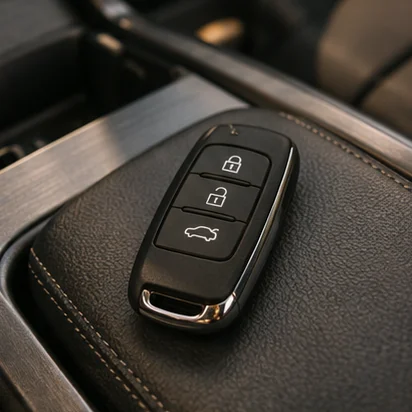
Blade, chip and remote each do a job
A key can have as many as three parts that do different things. The blade engages a mechanical cylinder. A transponder or electronic credential is recognized for starting. Remote buttons handle functions such as locking, unlocking or opening the trunk, depending on the vehicle. A push-button fob can still have a small backup blade hidden in the housing. That blade may matter in exactly the situation that leads you to call us, when the electronic side has stopped unlocking the door.
Think about which of those jobs your current key still does, even if the key looks broken. A remote with an unreliable button can still start the car, and a blade that fits the door can exist without a credential that starts it. If several drivers use the car, ask them whether the issue happens with every key. Bring the ones you intend to keep. The comparison gives us something concrete to work from and helps avoid replacing functions that still work normally.
Keep your key information with the vehicle records
After a fob replacement, make a note of which part you received and what functions were checked. A photograph of the exterior and the non-sensitive part label can help next time you discuss the key. Keep purchase and vehicle paperwork somewhere you can reach if you misplace the key again. For a fleet, note who was issued each key and where an authorized driver can get a spare without sharing keys across vehicles. A file that only names the make and model may still leave questions about the actual fob.
If you have an intermittent key and are planning a spare, write down when it fails. For some drivers the problem is limited to one button. For others the vehicle sometimes reports that the key is not detected. Say which function you are counting on for daily use. An existing key with a cracked case should be handled carefully while you arrange replacement, so you can keep its components and label available for comparison. Bring any secondary fob you plan to keep active and ask if it needs to be present for the work you authorize.
If the only key is lost away from the vehicle and you are still looking for it, call with the exact location and what evidence of ownership is readily available. We can discuss what changes if the key turns up before the visit.
A spare with a working key on hand
A spare starts with an existing reference. Bring the key you use every day and any extra blade or remote that belongs with the car. List which buttons you actually need. The second driver may only need a basic key, or they may depend on a remote liftgate or locking the vehicle from outside. If you have a fob with a cracked shell, tell us whether the buttons, battery cover or internal parts are affected. A housing, a blade and the electronics may be sold as separate parts.
For a shared family or work vehicle, decide who needs to carry the spare and where it will be stored. A spare kept in the same bag as the main key is unlikely to help with a loss. Ask what will be checked before you accept the work. On a vehicle with both blade and starting functions, try each one with the spare. Confirm whether the original remains usable as part of the same check. Do the button tests at the car so you can see the response directly.
When the last key disappeared
Have your proof of ownership or authority ready and say whether the car is at home, at a workplace or somewhere public. If it is in a Downtown or Buckhead parking deck, share the full garage entrance, floor and row in addition to the vehicle address. If an ignition or door lock was replaced previously, mention it because the keys that match those cylinders may have changed. If you leased or rented the vehicle, check who can approve replacement and what their return or key policy requires.
An all-keys-lost call may involve a different process from adding a spare. Ask which steps are included and what could change the quote once the vehicle is identified. If someone could still have the old key, explain your concern before programming starts. Depending on the vehicle, changing electronic access may be possible. A missing blade with mechanical access is a separate consideration. We can explain what a proposed job would address so you can decide whether any further work is worthwhile.
Checking a fob listing before buying
Two fobs may look alike in a listing and still be sold for different vehicle configurations. Compare the labeled part number, button layout and compatibility information for your vehicle. Say whether the seller identifies it as new, previously paired, refurbished or just an empty shell. Share a photo of the label if you already own it, but keep sensitive vehicle information out of a public listing or message. A matching case is useful to identify what you are holding. It cannot settle the electronic compatibility question on its own.
Ask whether the quote covers supplying a part, blade cutting, programming and a visit, or only the work to attempt to use a part you have brought. If the part does not fit, find out what the supplier will accept as a return. Confirm which functions matter most and whether the car has a previous aftermarket installation. Doing these checks before committing to a part can save you from paying for a remote whose buttons work differently from the one you expected.
Test one key at a time
Keep the existing keys apart while you test. Otherwise, a nearby fob could be the one the car is responding to when you think you are testing the new one. A demonstration should cover the functions you approved: how the door unlocks, whether the vehicle recognizes the key to start, and what the remote buttons operate. If a backup blade is part of the job, ask to see where it is stored and verify its fit. Put any paperwork or part information with your vehicle records afterward.
If your concern is mainly an unreliable key, note whether the replacement behaves more consistently than the old one did. If the new key shows the same issue, the symptom may need a different diagnosis. Tell us before leaving the meeting point if there is a function you expected that is missing. When you call, start with the vehicle and whether you have any working keys. From there we can talk through a replacement that fits how you actually use the car.
Questions about car key replacement
Can a remote unlock the car and still fail to start it?
Yes. Remote buttons and starting authorization use different functions. Tell us what you can still do with the key.
What should I bring for a spare?
Bring the working key, the vehicle and proof that you can authorize the work. Let us know about any other keys you want to keep using.