

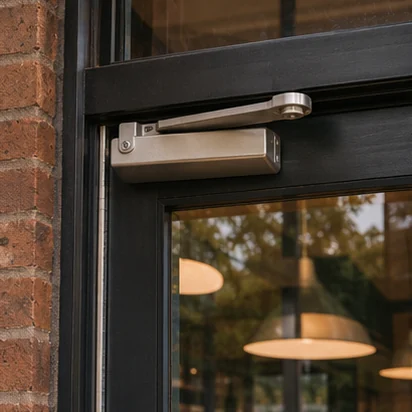
Watch the last few inches
From a safe position, watch the door pass through the last few inches of its swing. A door may move smoothly most of the way and stop when the latch reaches the strike. It may slam from a wide opening but shut more slowly from a smaller angle. Tell us whether it drags anywhere and whether the symptom appears every time. The last part of the swing is where closing, latching and locking come together. A difference between those three actions is often the most useful detail on the phone.
If the storefront has been getting louder, look for a visible leak near the closer or a screw or bracket that appears loose. Do not climb or take hardware apart to identify it. A photo of the top of the opening from floor level is enough to start a discussion. An aluminum storefront with glass needs care around the frame and glazing. Let us know right away if the glass or frame itself has been damaged so we can talk through which contractor and repair scope make sense.
The closer, latch and exit device belong to one opening
A surface closer controls motion. A latch holds a door in the closed position. An exit device lets someone open from inside by using the bar or pad, depending on the setup. Each can have a problem even when the others work, and each relies on a door sitting properly in the frame. A new latch cannot correct a sagging door by itself. An opening that rebounds when closing can put extra load on the hardware that is meant to catch it.
Tell us which side the door opens from, how the staff unlocks it in the morning and whether there is a bar, keypad or cylinder. Photograph labels and visible hardware without sharing codes or access credentials. For a required exit or a rated door, involve facilities management early and keep the opening's intended exit function available. If an existing component needs replacement, its role and the requirements for that particular opening matter alongside the size and the look.
When a photo is more helpful than a model guess
Take an overall photo from each side of the door, one at the edge when it is safe and one showing the top of the frame or trim from a normal standing position. If there is a visible mark or loose part, point to it rather than moving hardware. Keep security details, customer information and credentials out of the image. If the opening has a label you can read safely, send the make and model as written. A partial number makes a good starting point, but the fit and use of the whole opening still matter.
Let us know when the problem first showed up and whether deliveries, weather or recent work coincide with it. In a shared property, note whether another entrance remains available and who keeps it staffed. If work on the opening affects normal exit, ask the building team to handle that part of the planning. After the hardware has been assessed, put any part number and door identification into the same record. That gives the person who orders parts next time something more specific than a photo of the storefront.
Before you order trim based on that information, confirm which symptom the part is meant to solve. A hardware label identifies a component, while the behavior of the opening helps identify where the repair belongs.
Equipment comparisons
Hardware families you may already have
Use these models as reference points. Ask about fit, availability and the work your opening needs before choosing a part.
LCN 4040XP closer
The heavy-duty surface closer is one reference point for a high-use opening. Have the mount, arm configuration and door checked as part of a fit comparison.
Manufacturer detailsVon Duprin 98/99 exit devices
These are common examples of commercial exit-device families. Confirm the existing type, trim, opening dimensions and any rating before choosing a component.
Manufacturer detailsAdams Rite 4900 deadlatch
A reference for narrow-stile aluminum openings. Backset, handing and the associated trim help determine suitability on an existing storefront.
Manufacturer detailsPlan around the storefront or suite
A Peachtree corridor storefront may have a front entrance off a public sidewalk and a second entrance for deliveries. An office tenant may have approval to change a suite lock but need building sign-off for an exterior closer. Tell us whether the problem is on a customer door, a stockroom, a shared stairway or an exit. Include the suite number and the best place to meet. If the site uses a service dock, tell us which street leads to it and whether a visitor needs advance approval.
A repair can be easier to schedule when you know which opening can be taken out of everyday use for a short time and which has to stay available. Bring the person who can approve hardware changes into the conversation. For a door that cannot close all the way, mention whether employees still need to pass through it while you wait. A temporarily supervised entrance and a fully working door are different states. Decide who is responsible for the door until the work has been checked.
When a replacement part comes up
Ask whether the existing mounting pattern can be used, whether trim can be kept and what dimension or handing needs to be confirmed. A model name might describe a family with several variants. For a closer, the arm style and mounting arrangement matter. For an exit device, the opening width, existing trim and any rating can affect the selection. A narrow-stile latch uses the narrow metal section of a storefront door and needs the right fit. Matching the appearance is only one step in making the hardware work properly.
Ask for the scope in terms of what the opening should do once the job is finished. A closer adjustment may address door motion. A replacement latch can restore the part that holds the door. A damaged frame or glazing issue may call for different work. If a part has to be ordered, establish how access will be managed in the meantime. Keep the existing hardware details in the building records so the next person has a way to identify what was used.
Test the door during a normal cycle
When the opening is ready, test it as a customer or employee would. Release it from several normal positions and watch whether it closes and latches without assistance. Check the lock or authorized outside entry method and then try the inside exit hardware. For a paired opening, ask about the working order of both leaves. If an access control provider is involved, have them verify any reader or door-status behavior that belongs to their system.
Tell us if a door has recently been hit, changed or adjusted. A timeline helps put shifting symptoms in context. If you manage several openings, start with the one that fails to secure or interferes with normal exit. Once we understand that door and its operating requirements, we can explain which parts of the problem should be handled together and which require a separate trade.
Questions about commercial door repair
Do you work on the glass in a storefront?
This service focuses on door hardware and operation. Tell us if glazing, the frame or automatic door equipment is also affected so the required trades can be identified.
Can a closer cause a lock problem?
It can leave the door short of the strike or make it rebound. Describe what the door does at the end of each closing cycle.